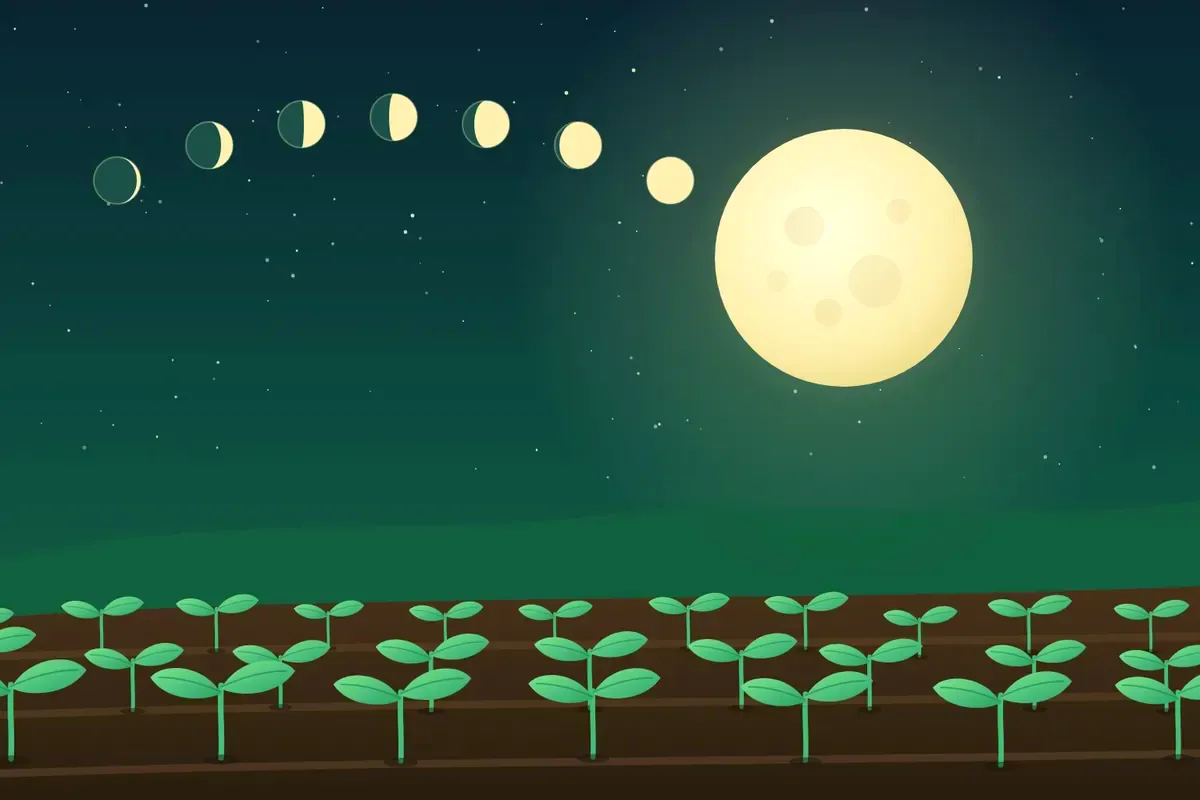
A traditional guide, not a sowing forecast. Check seed requirements and local conditions.
First quarterCycle day 8
48% illuminated at 12:00 noon (UTC).
Moon age: 7.8 days since new Moon.
Principal phase time
First quarter
Astronomy, calculated
Lunar day 8: Ashtami
Shukla paksha, the waxing half, at local noon.
Day 7 Oct 17, 00:25 to Oct 18, 02:59
Day 8 Oct 18, 02:59 to Oct 19, 05:22
Tradition, not a proven effect
Fruit day
Moon in Sagittarius at local noon, from Oct 16, 01:16 to Oct 18, 14:02. Traditionally linked with fruiting crops (tomato, pepper, cucumber, beans, grain).
More details: general guidance
These notes describe a season or phase, not a prescription for this particular date. Weather, soil and seed requirements come first.
Sow seeds: general guidance
Tradition sows above-ground crops while the Moon waxes and root crops while it wanes, ideally on the day type of the crop and not on the day of a new or full Moon. Check the species, sowing season and germination requirements first.
How is the lunar day counted?
A lunar day (tithi) lasts while the Moon moves 12 degrees ahead of the Sun, so there are 30 in a cycle and each lasts roughly 20 to 27 hours. Days 1 to 15 are the waxing half, 16 to 30 the waning half. It is calculated from the Sun and Moon, the same everywhere; only the local clock times change with your time zone.
How are root, leaf, fruit and flower days chosen?
From the Moon’s sign in the sidereal zodiac (Lahiri, equal 30-degree signs): earth signs give root days, water signs leaf days, fire signs fruit days and air signs flower days. This follows biodynamic and folk calendars; calendars that use the unequal star constellations may differ by about a day. It is a tradition, not a proven effect on plants or yield.
How is the cycle day counted?
At local noon, using 24-hour intervals from the exact new Moon. Day 1 starts at new Moon; the count resets at the next new Moon. A cycle averages 29.53 days, not 28. It differs from the lunar day (tithi) above, which follows the Sun–Moon angle.
Choose your climate, then select a day to see guidance.
Not sure? You can still explore Moon phases without choosing.
October 2026
Crop
Astronomy only until you choose a climate. Select any day to explore.
Day types by tradition: RootLeafFruitFlower
MonTueWedThuFriSatSun
Lunar planting calendar
Astronomy and tradition are different. Weather, soil and seed requirements come first.
More about this calendar
Follow the Moon precisely, then plan garden work around your real season, soil and weather.
Astronomical phases and times are calculated data. Lunar planting notes are clearly labelled traditional guidance, not proven effects on plant physiology. Weather, soil condition, soil temperature, frost risk, seed packet instructions and reliable local advice should guide decisions first.
How these highlights work
Deodar uses a simplified convention from folk and biodynamic calendars: sowing above-ground crops during the waxing half and root crops during the waning half, transplant preparation from first quarter to full Moon, pruning, feeding and harvesting for storage while the Moon wanes, watering on leaf days, seed collection on fruit days and maintenance from last quarter to new Moon. When you pick a crop, the day type must match it too, and sowing, transplanting and pruning skip the new and full Moon dates. The selected profile supplies seasonal context, not a local suitability forecast. Highlights use the phase at local noon, not an all-day guarantee.
Choose your climate profile to see broad seasonal priorities. The Moon phase and principal phase times are astronomical calculations. Planting suggestions linked to lunar phases are traditional practice, not established plant science.
Let local conditions lead
Check seed packet instructions, soil temperature, moisture, frost risk and guidance from a trusted local extension service before scheduling garden work.
Common questions
About this lunar calendar
Are lunar planting days scientifically proven to improve germination or yield?
Reliable evidence is not established. This calendar labels lunar planting notes as tradition and gives weather, soil temperature, frost risk and crop instructions higher priority.
Why does the calendar ask for my time zone?
A principal Moon phase happens at one instant worldwide, but its local date and clock time depend on your time zone. No coordinates or geolocation are used.
Which climate profile should I choose?
Choose Northern temperate or Southern temperate if your seasons follow those patterns. Choose Tropical or frost-free for a year-round context without assuming universal wet and dry seasons.
What should take priority over a traditional lunar note?
Your seed packet, current weather, soil condition, suitable temperature, frost risk and local professional advice should always take priority.
 Visit deodar-seeds.in